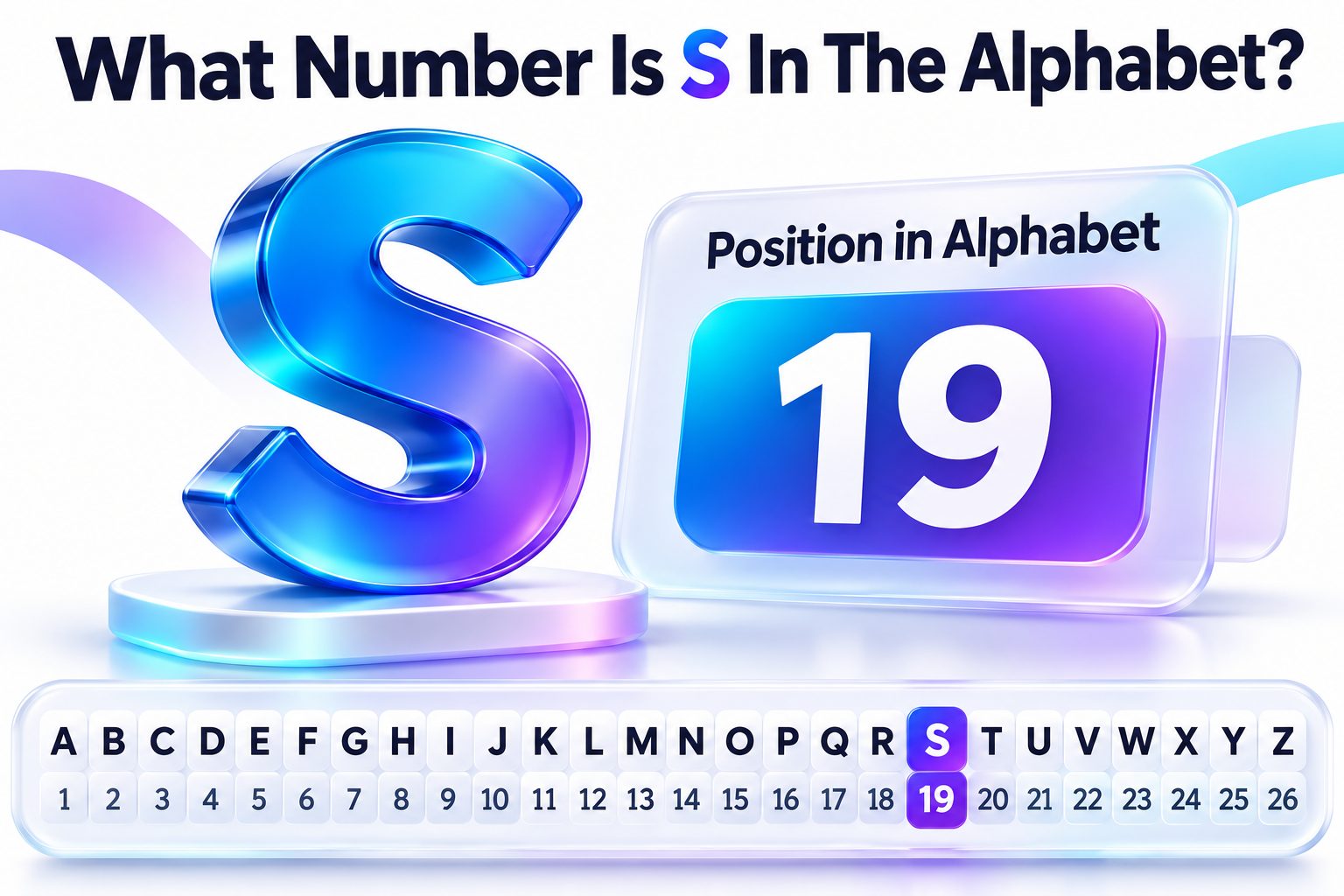
The letter S is the 19th letter of the English alphabet. If you assign numbers in alphabetical order, beginning with A as 1, B as 2, and C as 3, then S equals 19. It comes immediately after R, which is number 18, and before T, which is number 20.
People often search “what number is s in the alphabet” while solving puzzles, decoding letter-number combinations, checking initials, or helping children learn alphabetical order. The answer is straightforward, but the way letters are numbered can vary in certain contexts. Most everyday questions use the standard A1Z26 system, where each of the 26 English letters receives a value from 1 to 26.
This article explains how to find the position of S quickly, how common alphabet-number systems work, and when S may have a value other than 19. You will also find practical examples involving names, spreadsheets, numerology, computer indexing, and reverse alphabet codes. By the end, you will be able to identify the numerical position of any letter without having to memorize the entire alphabet.
The Alphabetical Position of S
In the standard English alphabet, S has the numerical position 19. This result comes from counting every letter in order, with A as the first letter. Continuing through the sequence places Q at 17, R at 18, S at 19, and T at 20.
The answer does not change when S is written in lowercase. Uppercase S and lowercase s represent the same letter, so both have the alphabetical value 19. Capitalization affects appearance and grammar, but it does not affect a letter’s position.
Letters Near S in the Alphabet
S appears in the later portion of the alphabet, between R and T. Looking at nearby letters is often the fastest way to confirm its position because many people already remember that T is the 20th letter.
The local sequence is P, Q, R, S, T, U. Their corresponding values are 16, 17, 18, 19, 20, and 21. This short run makes it easy to check S without counting all the way from A each time.
Important facts about S include:
- S is the 19th letter of the English alphabet.
- R comes directly before S and has a value of 18.
- T comes directly after S and has a value of 20.
- Uppercase S and lowercase s have the same position.
- The reverse alphabetical position of S is 8.
- In zero-based indexing, S may be represented by 18.
- The standard letter-number pairing is commonly called A1Z26.
The Standard A1Z26 Letter-Number System
A1Z26 is a simple system that matches each letter with its normal position in the alphabet. The name describes the range: A equals 1, while Z equals 26. Under this system, S equals 19.
This method appears frequently in classroom exercises, word puzzles, escape-room clues, basic ciphers, and aptitude tests. Unless a problem supplies a different rule, A1Z26 is usually the intended system when someone asks for the number of a letter.
The Complete Alphabet Number Chart
A full chart is useful when a task involves several letters rather than S alone. It also prevents common counting errors around the middle and end of the alphabet.
Letter | Number | Letter | Number
A | 1 | N | 14
B | 2 | O | 15
C | 3 | P | 16
D | 4 | Q | 17
E | 5 | R | 18
F | 6 | S | 19
G | 7 | T | 20
H | 8 | U | 21
I | 9 | V | 22
J | 10 | W | 23
K | 11 | X | 24
L | 12 | Y | 25
M | 13 | Z | 26
This chart shows that the alphabet divides neatly after M. M is number 13, N is number 14, and S appears five positions after N. Readers working with several letter values may also find [Internal Link: Alphabet Letters and Numbers] useful.
A Quick Method for Finding the Number of S
You do not need to count from A every time. One convenient reference point is M, the 13th letter. From M, count forward: N is 14, O is 15, P is 16, Q is 17, R is 18, and S is 19.
Another reliable shortcut uses T. Since T is widely remembered as the 20th letter, the letter immediately before it must be number 19. That letter is S. This approach takes only a second and reduces the chance of losing your place while counting.
Finding Any Letter’s Position
The same method works for every letter. Begin with a familiar anchor, such as A at 1, M at 13, or Z at 26, and count forward or backward until reaching the target letter.
For letters near the end, counting backward from Z may be faster. S is seven letters before Z when counting movement between positions, so 26 minus 7 equals 19. Care is needed because counting letters and counting the spaces between them can produce different totals.
A simple process is:
1. Write the alphabet in its normal order if it is not already visible.
2. Assign A the number 1.
3. Increase the number by one for every following letter.
4. Stop when you reach the target letter.
5. Check the answer against a nearby landmark, such as M at 13 or Z at 26.
For S, the sequence ends at 19. If you obtain 18 or 20, check whether you started with A at zero or accidentally selected R or T.
Practical Uses for the Number 19
Knowing that S is number 19 can help with more than a basic alphabet question. Letter positions are used in word-value calculations, substitution codes, logic problems, educational activities, and systems that convert labels into numeric data.
The correct use depends on the rule supplied by the activity. A school worksheet will probably use A1Z26, while a programming task may begin counting at zero. Recognizing the system before calculating prevents an otherwise correct method from producing the wrong result.
Word and Name Values
Some puzzles assign each letter its alphabetical value and add the numbers together. For example, SUN becomes S = 19, U = 21, and N = 14. Its total is 54 because 19 + 21 + 14 equals 54.
The name SAM can be calculated in the same way. S equals 19, A equals 1, and M equals 13, producing a total of 33. Such totals do not have a universal meaning unless the puzzle or method defines one.
Codes and Puzzles
In an A1Z26 code, the sequence 19-20-1-18 spells STAR. The numbers correspond to S, T, A, and R. To decode a longer sequence, convert each number separately and preserve spaces or punctuation where the puzzle indicates word breaks.
Puzzle makers may reverse the process by turning letters into numbers. For example, the word SEA becomes 19-5-1. Checking each value individually is more dependable than trying to calculate an entire word mentally in one step.
Practical examples include:
- S alone becomes 19.
- SO becomes 19-15.
- SUN becomes 19-21-14.
- STAR becomes 19-20-1-18.
- SEA becomes 19-5-1.
- SUCCESS begins and ends with the value 19.
- The initials S.T. become 19-20 under A1Z26.
Zero-Based Alphabet Numbering
Not every system starts with A as 1. Computers and programming languages frequently use zero-based indexing, meaning the first item in a sequence has index 0. In that arrangement, A is 0, B is 1, and S is 18.
This does not mean S has stopped being the 19th letter. Its position remains 19, but its index is 18 because an index measures its location in a list that begins at zero. Confusing position with index causes many off-by-one errors.
Alphabet Position Versus Index
A position describes where an item falls when people count in ordinary language. The first item is position 1. An index is a technical label used to locate an item in a data structure, and many systems label the first item 0.
System | Value of A | Value of S | Value of Z
Standard A1Z26 | 1 | 19 | 26
Zero-based indexing | 0 | 18 | 25
Reverse alphabet | 26 | 8 | 1
Always look for instructions such as “A = 0” or “use zero-based indexing.” If no special rule appears in a general alphabet question, S should be given as 19.
Reverse Alphabet Values
A reverse alphabet system gives Z the value 1 and A the value 26. Each letter’s value is therefore the opposite of its normal A1Z26 value. In this system, S equals 8.
You can calculate a reverse value by subtracting the standard value from 27. Since S normally equals 19, the calculation is 27 minus 19, which equals 8. Reverse values often appear in ciphers and reasoning tests.
Checking a Reverse Value
A useful check is to add the standard and reverse values. The result should always be 27. For S, 19 plus 8 equals 27, confirming that both values have been assigned correctly.
Nearby reverse values also follow a clear pattern. R has a reverse value of 9, S has 8, and T has 7. As letters move forward in the normal alphabet, their reverse values decrease by one.
Quick tips for avoiding confusion:
- Use 19 for S unless the instructions define another system.
- Use 18 only when a sequence explicitly begins with A at 0.
- Use 8 when Z equals 1 and the alphabet runs backward.
- Write the conversion rule above your work before solving a long code.
- Check whether the task asks for a position, an index, or a calculated value.
- Test the rule with A and Z when the instructions seem unclear.
The Letter S in Spreadsheets
Spreadsheet columns use letters as labels, but their numbering follows a pattern that extends beyond the 26-letter alphabet. Column A is 1, B is 2, and S is 19, so a direct alphabet-to-column conversion gives S the same value as A1Z26.
After Z, spreadsheets continue with AA, AB, AC, and other multi-letter labels. These labels behave more like base-26 numbers without a zero digit than a simple repeated alphabet. The distinction matters when converting columns beyond Z.
Single-Letter Columns
For single-letter spreadsheet columns, the conversion is straightforward. Column S is the 19th column, positioned between column R at 18 and column T at 20.
A formula or script may represent that column internally using a zero-based array index. In that case, column S could be stored at index 18 even though users see it as the 19th column. The interface and the code may therefore show different numbers.
Multi-Letter Columns
With multi-letter labels, each character contributes to the final column number. AA is column 27, not column 1 repeated twice. AB is 28, and AS is 45.
To calculate AS, treat A as one group of 26 columns and add S. The calculation is 1 × 26 + 19, giving 45. For broader spreadsheet conversions, see [Internal Link: Excel Column Letter to Number].
S in ASCII and Unicode
Alphabetical position is different from a character’s computer encoding. In ASCII and Unicode, uppercase S has decimal code point 83, while lowercase s has decimal code point 115. These numbers identify stored characters rather than alphabetical order.
A question asking for the “number of S” may therefore need context. In an alphabet exercise, the answer is 19. In a coding problem asking for an ASCII value, the answer could be 83 or 115 depending on capitalization.
Choosing the Correct Numeric Value
Look for terms that reveal the intended system. “Alphabet position,” “letter number,” and “A1Z26” point to 19. “Array index” may indicate 18. “ASCII code” points to 83 for uppercase S, while “Unicode code point” may be written as U+0053.
Capitalization matters in character encoding because uppercase and lowercase letters are separate symbols. It does not matter when determining alphabetical position. Both S and s remain the 19th letter.
A quick reference checklist:
- Alphabet position of S: 19
- A1Z26 value of S: 19
- Zero-based index of S: 18
- Reverse alphabet value of S: 8
- Uppercase S in decimal ASCII: 83
- Lowercase s in decimal ASCII: 115
- Spreadsheet column S: 19
- Unicode for uppercase S: U+0053
- Unicode for lowercase s: U+0073
Common Mistakes When Numbering S
The most frequent error is an off-by-one result. Someone begins with A at 0 without realizing it, or counts the movement between letters instead of their positions. Either mistake can make S appear to equal 18 rather than 19.
Another mistake is mixing an alphabetical value with a code point. ASCII 83 and Unicode U+0053 are valid identifiers for uppercase S, but neither answers a normal question about where S appears in the alphabet.
Counting From an Incorrect Anchor
Memorized reference points help only when they are correct. M is the 13th letter, N is the 14th, and T is the 20th. Starting with M as 12 shifts every later answer down by one.
When uncertain, divide the alphabet into manageable groups or write it out. A quick written check is often faster than correcting a long calculation based on a mistaken anchor.
Confusing Reverse and Standard Values
Reverse alphabet exercises sometimes look almost identical to standard A1Z26 questions. The key difference is the assigned starting point. If Z equals 1, then S equals 8 rather than 19.
Never assume that a numbered code uses the usual direction. Read the example supplied with the puzzle. If A maps to 26 or Z maps to 1, the code is reversed.
Do and don’t reminders:
- Do use 19 for the standard alphabetical position of S.
- Do verify whether numbering begins at 0 or 1.
- Do preserve capitalization when working with ASCII or Unicode.
- Do check examples provided in puzzles and worksheets.
- Don’t treat the reverse value 8 as the ordinary position.
- Don’t confuse a spreadsheet’s visible column number with an internal index.
- Don’t add letter values unless the activity specifically calls for a total.
Teaching Children Where S Appears
Children often remember letter positions more easily when numbers are attached to songs, alphabet cards, or physical objects. A card showing “S — 19” connects the letter’s shape, sound, and position without turning the exercise into pure memorization.
It also helps to group S with nearby letters. Practicing “Q is 17, R is 18, S is 19, T is 20” builds a short pattern that is easier to retain than an isolated fact.
Simple Practice Activities
One activity is to place numbered cards from 1 to 26 on a table and ask the learner to match letter cards to them. Another is to remove S and ask which letter belongs between R and T.
Learners can also encode short words such as SUN or STAR. Turning familiar words into number sequences gives the alphabetical positions a practical purpose and reinforces careful left-to-right matching.
Useful activities include:
1. Write A through Z and number each letter from 1 to 26.
2. Circle S and the two neighboring letters.
3. Say the sequence “R, S, T” with the numbers 18, 19, and 20.
4. Convert S-led words such as SUN, SEA, and STAR into numbers.
5. Reverse the exercise by asking which letter matches the number 19.
6. Repeat the activity without looking at the chart.
Why S Is the 19th Letter
The modern English alphabet contains 26 letters arranged in a conventional sequence inherited through earlier writing systems. Within that established order, eighteen letters appear before S, making S the 19th item.
Its position is a matter of sequence rather than frequency or importance. Although S is common in English and often marks plural nouns, its usage does not determine its number. Alphabetical position depends only on where the letter occurs in the accepted order.
Position and Frequency Are Different
Letter frequency measures how often a letter appears in a body of text. Alphabet position measures where it appears from A to Z. A frequently used letter can occur anywhere in the sequence.
This distinction matters in word games and cryptography. A frequency chart might rank S differently depending on the text being studied, but a standard alphabet chart will always place it at 19.
The Role of S in English
S commonly represents an unvoiced sound, as in “sun,” or a voiced sound, as in “rose.” It also appears in plural endings, possessive forms, and many verb forms. These grammatical roles make it highly recognizable.
None of these functions changes its numerical position. They simply explain why S appears frequently in written English and why it is often used in classroom examples, word-value puzzles, and elementary codes.
Conclusion
The direct answer to “what number is s in the alphabet” is 19. Under the standard A1Z26 method, A begins at 1, R is 18, S is 19, and T is 20. Uppercase and lowercase forms share the same alphabetical position.
Context matters when a task uses a different numbering rule. S has index 18 in a zero-based sequence and value 8 in a reverse alphabet where Z equals 1. In computing, uppercase S has decimal ASCII value 83, while lowercase s has value 115. Spreadsheet column S is the 19th column, although software code may refer to it using index 18.
For an ordinary worksheet, puzzle, trivia question, or alphabet exercise, use 19 unless the instructions explicitly define another system. Remembering that T is number 20 provides a quick check: S comes directly before T, so it must be number 19. That simple reference point is usually enough to answer confidently without counting from the beginning.
Frequently Asked Questions
What letter is number 19 in the alphabet?
The letter at position 19 is S. Counting from A as 1 places R at 18, S at 19, and T at 20. This answer applies to both uppercase S and lowercase s.
What is the reverse alphabet number of S?
The reverse alphabet value of S is 8 when Z equals 1 and A equals 26. You can verify it by subtracting the standard value from 27: 27 minus 19 equals 8.
Is S number 18 or 19?
S is the 19th letter in ordinary alphabetical numbering. It is assigned index 18 only in zero-based systems where A starts at 0, a convention commonly used in programming and data structures.
What number is lowercase s?
Lowercase s is number 19 in the alphabet, just like uppercase S. Capitalization does not change alphabetical position, although it does change computer character codes such as ASCII and Unicode values.
What number is S in ASCII?
Uppercase S has decimal ASCII value 83, while lowercase s has value 115. These are character-encoding values, not alphabet positions. In the standard alphabet, both forms of the letter occupy position 19.