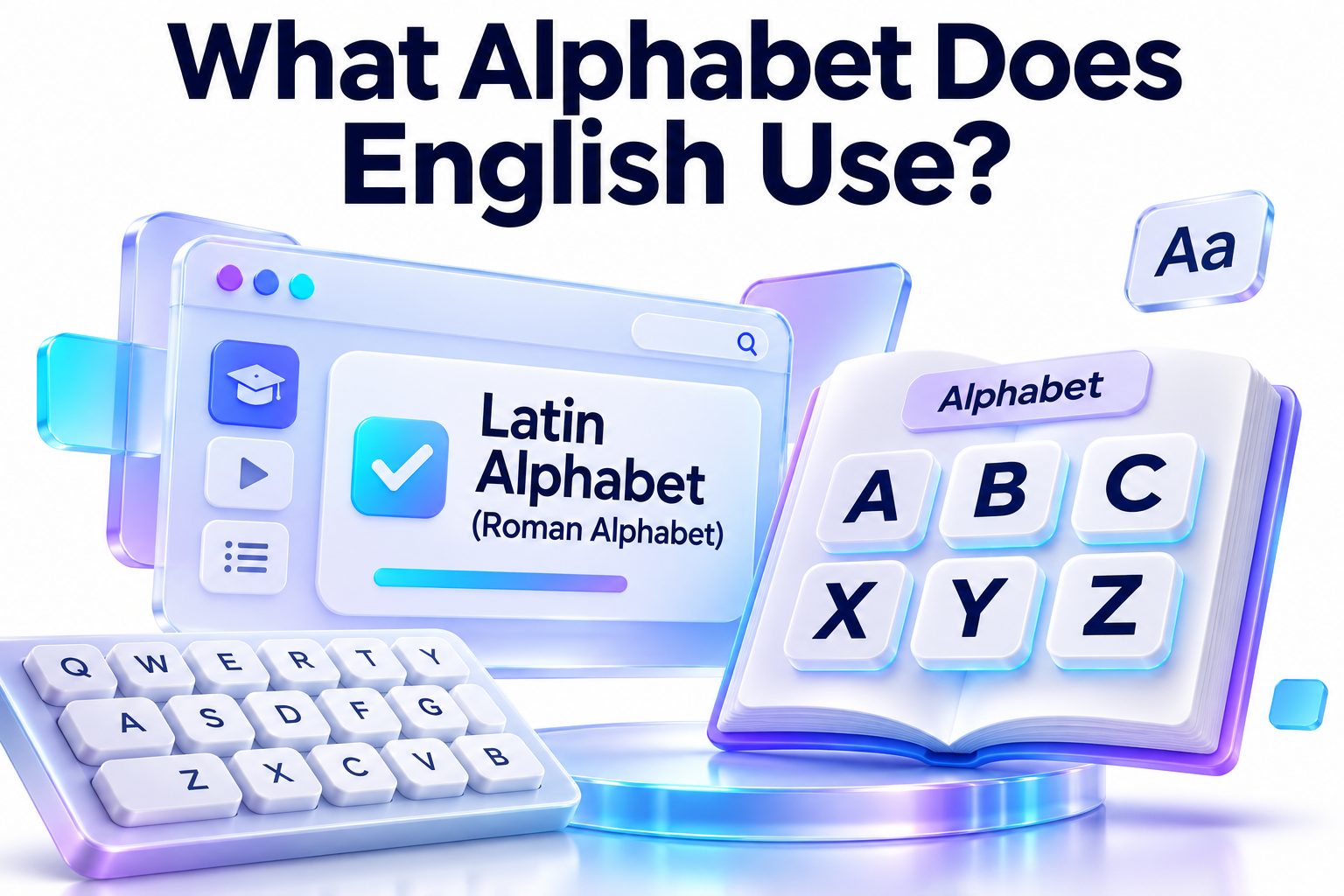
English is written with the Latin alphabet, also called the Roman alphabet. More specifically, modern English uses a 26-letter version consisting of A through Z. If you are wondering what alphabet does English use, that is the direct answer. The system includes uppercase and lowercase forms, but they represent the same 26 letters rather than 52 separate characters.
The answer becomes more interesting when you look beyond the letter count. English adopted the alphabet from Latin through centuries of cultural contact, then adjusted it to represent sounds that classical Latin did not have. Some older English letters disappeared, while letters such as J, U, and W became established relatively late. English spelling also uses letter combinations, borrowed words, accent marks, and punctuation to express more than the basic alphabet can handle alone.
This article explains the English alphabet, its historical development, letter names, alphabetical order, pronunciation, and differences from other writing systems. It also covers common misconceptions, nonstandard marks, and practical examples of how the alphabet works in everyday English.
The Alphabet Used by English
Modern English uses the Latin alphabet, the writing system that developed from the alphabet used in ancient Rome. It is often called the Roman alphabet for that reason. English shares this alphabet with many languages, including Spanish, French, German, Italian, and Portuguese.
The English version contains 26 letters. Each has an uppercase form, such as A, and a lowercase form, such as a. Uppercase and lowercase forms differ in appearance and grammatical use, but they are not considered separate letters.
The 26 Letters of the English Alphabet
The letters appear in this standard order:
A, B, C, D, E, F, G, H, I, J, K, L, M, N, O, P, Q, R, S, T,
Lowercase letters follow the same order:
a, b, c, d, e, f, g, h, i, j, k, l, m, n, o, p, q, r, s, t,
Alphabetical order matters in dictionaries, indexes, directories, filing systems, glossaries, and databases. When words begin with the same letter, their second letters are compared, followed by their third letters, until their order becomes clear. For example, “cap” comes before “car” because p appears before r.
Uppercase and Lowercase Letters
Uppercase letters are used at the beginning of sentences and for proper nouns such as Maria, London, Monday, and English. They also appear in initialisms and abbreviations, including BBC, DNA, and USA. Lowercase letters make up most ordinary written text.
Some uppercase and lowercase pairs have similar shapes, including C and c, while others look notably different, such as G and g. Fonts and handwriting styles can introduce further variations. These visual differences do not change a letter’s identity or its place in the alphabet.
Vowels and Consonants in English
The 26 letters are traditionally divided into vowels and consonants. A, E, I, O, and U are the five standard vowel letters. The remaining 21 are generally classified as consonant letters.
Y can serve either role depending on the word. It acts like a consonant at the beginning of “yes” and like a vowel in “myth” or “happy.” This flexibility concerns how the letter functions in a word, not its official position in the alphabet.
Important Facts About the English Alphabet
- English has 26 standard letters.
- The writing system is a form of the Latin or Roman alphabet.
- Every letter has an uppercase and lowercase form.
- A, E, I, O, and U are the standard vowel letters.
- Y sometimes represents a vowel sound.
- English letters do not each correspond to only one sound.
- Accent marks are not part of the standard English alphabet.
- Alphabetical order runs from A to Z.
How English Came to Use the Latin Alphabet
English did not begin with its present writing system. Before widespread use of Latin letters, early Germanic communities in Britain sometimes wrote with runes. The runic system associated with Old English is commonly called the Anglo-Saxon futhorc.
Following the arrival of Christian missionaries from the late sixth century onward, Latin literacy spread through religious institutions. Scribes began using Latin letters to record English, but they needed extra symbols and spelling practices for sounds not represented neatly by the Latin system.
Old English Letters No Longer in Standard Use
Old English included letters that are absent from the modern alphabet. Thorn, written Þ or þ, represented a “th” sound. Eth, written Ð or ð, could also represent sounds now spelled with th. Ash, Æ or æ, represented a vowel sound.
Wynn, written Ƿ or ƿ, was used for a sound now represented by W. Another character, yogh, appeared later in Middle English and could represent several sounds. Changes in handwriting, printing, language contact, and spelling conventions eventually pushed these characters out of standard English.
The Influence of Norman French
The Norman Conquest of 1066 brought major French influence to English administration, literature, vocabulary, and spelling. Anglo-Norman scribes introduced or encouraged several conventions that changed how English words were written.
French influence helped replace older symbols with familiar letter combinations. Thorn and eth gradually gave way to th, while other spellings shifted according to scribal habits. English retained the Latin alphabet but adapted its use as pronunciation and vocabulary changed.
Printing and Alphabet Standardization
The printing press contributed to more consistent spelling and letter use. Early printers faced practical limits because type was often produced for continental European languages and did not always include traditional English characters.
Printing did not standardize English overnight, but it encouraged widely recognizable forms. Over time, dictionaries, schools, publishers, and official institutions reinforced the 26-letter sequence now taught as the English alphabet.
How J, U, and W Became Separate Letters
The alphabet inherited from Latin did not originally distinguish every letter in the way modern English does. I and J were once treated as variants, as were U and V. Their shapes and functions separated gradually through medieval and early modern writing.
W developed from a doubled U or V form, which explains its English name, “double-u.” By the modern period, J, U, and W had become distinct letters with their own names, uses, and positions in alphabetical order.
English and Classical Latin Compared
Classical Latin did not use the same 26-letter inventory familiar to modern English readers. Its writing lacked separate J, U, and W letters in their modern roles. English therefore uses the Latin alphabet in an adapted form rather than copying the ancient Roman system exactly.
This distinction matters when someone asks whether English uses a “Latin” or “English” alphabet. “Latin alphabet” identifies the broader writing tradition, while “English alphabet” refers to the particular 26-letter set and conventions used for English.
Quick Historical Timeline
1. Early Germanic settlers in Britain use runes for some inscriptions.
2. Christian missionaries and scribes introduce Latin literacy.
3. Old English combines Latin letters with symbols such as thorn and wynn.
4. Norman French influences English spelling after 1066.
5. Older letters gradually disappear or are replaced by letter combinations.
6. Printing encourages more consistent letter forms and spelling practices.
7. J, U, and W become recognized as distinct letters.
8. The modern 26-letter English alphabet becomes standard.
Letters and Sounds Are Not the Same
An alphabet provides written symbols, but speech is made of sounds. English has 26 letters yet considerably more distinct speech sounds. The exact number varies by dialect and method of analysis, but it is commonly estimated at around 40 to 45 phonemes.
Because there are fewer letters than sounds, English frequently uses one letter for several sounds or combines letters to represent a single sound. This is one reason English spelling can be difficult for learners and native speakers alike.
One Letter Can Represent Different Sounds
The letter c represents different sounds in “cat” and “city.” The letter g changes between “go” and “giant.” Even vowel letters vary widely: a sounds different in “cat,” “father,” “cake,” and “about.”
Pronunciation also varies across regional accents. A written word can remain the same while speakers in England, Scotland, the United States, India, Australia, or Nigeria pronounce parts of it differently.
Several Letters Can Represent One Sound
English often uses digraphs, which are pairs of letters representing a sound or a closely connected sound sequence. Common examples include sh in “ship,” ch in “chair,” th in “thin,” and ng in “sing.”
Some combinations have several possible pronunciations. The ch in “chair” differs from the ch in “chorus” and “machine.” Spelling must therefore be learned through vocabulary and patterns rather than by applying a single sound to each letter.
Silent Letters
Some written letters are not pronounced in common modern speech. Examples include k in “knee,” w in “write,” b in “debt,” and l in “walk.” Silent letters often reflect a word’s history, an older pronunciation, or spelling influenced by another language.
They may seem unnecessary, but they can distinguish words and reveal relationships. The silent g in “sign,” for instance, becomes audible in the related word “signature.” Studying [Internal Link: English Spelling Rules] can help readers recognize such patterns.
English Alphabet and the International Phonetic Alphabet
The International Phonetic Alphabet, usually abbreviated IPA, is not the alphabet used for ordinary English writing. It is a specialized system designed to represent speech sounds accurately across languages.
Dictionaries may show an English word in regular spelling followed by an IPA transcription. For example, a dictionary can use phonetic symbols to distinguish pronunciations that ordinary spelling leaves unclear. Those symbols support pronunciation instruction but do not replace standard English letters.
Practical Examples of Letters and Sounds
- C sounds like k in “cat” but like s in “cent.”
- G has a hard sound in “gate” and a soft sound in “gem.”
- X commonly represents two sounds in “box.”
- Sh uses two letters for one consonant sound in “shop.”
- Th represents different sounds in “thin” and “this.”
- K is silent at the beginning of “knife.”
- The vowel combination ea differs in “bread,” “bead,” and “break.”
- Ough has different pronunciations in “though,” “through,” “rough,” and “thought.”
English Compared With Other Alphabets and Writing Systems
English shares its basic alphabet with numerous European languages, but each language modifies or applies the system differently. Spanish uses Ñ, for example, while German uses Ä, Ö, Ü, and ß alongside its standard Latin letters.
These characters do not automatically belong to the English alphabet just because they appear in languages that use Latin-based writing. Each language has its own recognized inventory, spelling rules, and conventions.
Latin Alphabet Versus Cyrillic Alphabet
The Cyrillic alphabet is used for languages including Russian, Bulgarian, and Serbian, although Serbian also uses Latin script. Some Cyrillic letters resemble Latin ones but represent different sounds.
For example, Cyrillic В corresponds approximately to the English V sound, not B. Visual similarity can therefore be misleading. English remains a Latin-alphabet language even when borrowed names are transliterated from Cyrillic.
Latin Alphabet Versus Greek Alphabet
Greek has its own alphabet, including letters such as alpha, beta, gamma, and delta. The Latin alphabet developed through earlier writing traditions connected to Greek, so historical relationships and visual similarities exist.
Modern English does not use Greek letters as standard alphabet members. Greek symbols may appear in mathematics, science, fraternities, and specialist terminology, but those uses do not add them to the English alphabet.
Alphabetic Writing Versus Character-Based Systems
English is alphabetic because its letters broadly represent speech sounds, even though the relationship is inconsistent. Chinese writing operates differently, using characters that generally represent meaningful units rather than individual consonants and vowels in the English manner.
Japanese combines several systems, including kanji and the syllabic kana scripts. Arabic and Hebrew use writing systems in which consonants have a particularly central role. These differences show that not every written language organizes speech through a 26-letter-style alphabet.
Comparison of Selected Writing Systems
System | Example languages | Basic principle | Relation to English
Latin alphabet | English, French, Spanish | Letters represent speech sounds | English uses a 26-letter version
Cyrillic alphabet | Russian, Bulgarian | Letters represent speech sounds | Separate alphabet with some similar-looking forms
Greek alphabet | Greek | Letters represent speech sounds | Historically related but not used for ordinary English
Arabic script | Arabic, Persian | Consonant-centered alphabetic writing | Different characters and right-to-left direction
Chinese characters | Chinese languages | Characters represent meaningful units | Not an alphabet in the English sense
Japanese scripts | Japanese | Characters and syllabic signs | Combines several writing systems
Accent Marks and Borrowed Words in English
Accent marks are not standard English alphabet letters, but they sometimes appear in borrowed words and names. Examples include café, résumé, naïve, façade, jalapeño, and São Paulo. Writers may preserve the original marks to signal pronunciation, origin, or preferred spelling.
English publications sometimes omit accents, producing “cafe” or “resume.” Whether that is appropriate depends on the word, audience, house style, and the preferences of people whose names are being written. Proper names should be reproduced accurately whenever possible.
Ligatures and Special Letter Forms
A ligature combines two characters into one visual form. The forms æ and œ may appear in older spellings, academic writing, or words borrowed from other languages. Modern English usually replaces them with separate letters or simplified spellings.
Typography may also display combinations such as fi and fl as joined glyphs. These are visual design choices, not additional alphabet letters. The underlying text still consists of the separate characters f plus i or f plus l.
Apostrophes, Hyphens, and Punctuation
An apostrophe can appear inside an English word, as in “don’t” or “teacher’s,” while a hyphen connects elements in terms such as “well-known.” Neither symbol is a letter. Punctuation organizes meaning but is not part of the alphabet.
The same principle applies to numerals, currency symbols, mathematical signs, and emoji. English writing uses all of these, yet the alphabet itself remains limited to A through Z.
Best Practices for Non-English Marks
- Preserve diacritics in personal and place names when the correct spelling is known.
- Follow a publication’s style guide for common borrowed words.
- Do not treat accented characters as additional English alphabet letters.
- Use proper Unicode characters instead of substituting visually similar symbols.
- Check pronunciation rather than assuming an accent mark works the same in every language.
- Avoid removing marks from names merely for convenience when software supports them.
Alphabetical Order in Everyday Use
Alphabetical order arranges words according to the established sequence from A to Z. It helps readers find entries quickly in dictionaries, glossaries, indexes, contact lists, catalogs, and reference materials.
Digital search has reduced the need to scan long alphabetical lists manually, but alphabetization still supports predictable organization. Menus, directories, bibliographies, and administrative records often depend on it.
Sorting Words Letter by Letter
To alphabetize words, compare their first letters. If those match, compare the second letters, then continue until a difference appears. “Ball,” “bank,” and “bat” all begin with ba, so their third letters determine the sequence.
When one word forms the complete beginning of another, the shorter word usually comes first. For example, “art” precedes “artist.” Rules for spaces, hyphens, numbers, and names can vary between style guides and software systems.
Alphabetizing Names
Names may be sorted by surname in directories and bibliographies, producing an order such as Angelou, Maya; Austen, Jane; and Baldwin, James. Some systems instead sort by the full displayed name.
Prefixes, particles, compound surnames, and naming traditions require care. A rigid rule designed for English-language names may mishandle names from other cultures. Professional databases should include dedicated fields and respect each person’s stated form of name.
Case and Computer Sorting
Humans generally treat uppercase and lowercase forms as equivalent when alphabetizing ordinary words. Computers may not. A case-sensitive system can place capitalized entries in a different group from lowercase entries.
Software may also sort accented letters, punctuation, and numbers differently depending on language settings. When exact ordering matters, choose the correct locale and review the results instead of assuming every program follows dictionary order.
Numbered Steps for Alphabetizing a List
1. Convert entries to a consistent display format.
2. Decide whether names will be sorted by first name or surname.
3. Ignore capitalization unless the required system is case-sensitive.
4. Compare entries one letter at a time from left to right.
5. Place a shorter complete word before its longer extension.
6. Apply one consistent rule to spaces, hyphens, and apostrophes.
7. Review accented letters and non-English names manually.
8. Confirm that the final order matches the intended language or style guide.
Common Misconceptions About the English Alphabet
One frequent misconception is that English has 52 letters because it has 26 uppercase forms and 26 lowercase forms. In linguistic and educational terms, English has 26 letters, each with two main cases.
Another misconception is that every English letter represents one fixed sound. English spelling reflects centuries of language change and borrowing, so the connection between symbols and pronunciation is far less regular.
English Is Not Written in the Cyrillic Alphabet
Some people confuse an alphabet with a language. English is a language; the Latin alphabet is its standard writing system. Russian is another language, and it is normally written in Cyrillic.
A language can sometimes be represented in more than one script. English can be transliterated experimentally into other systems, but standard English publishing, education, government, and communication use Latin letters.
Old English Is Not Simply Modern English in an Old Font
Old English was an earlier stage of the language with different grammar, vocabulary, sounds, and letters. It cannot be converted into modern English merely by changing the typeface.
Texts may include Latin letters alongside thorn, eth, ash, and wynn. Reading them requires knowledge of the historical language, not only familiarity with decorative or archaic typography.
Fonts Do Not Change the Alphabet
A serif font, sans-serif font, cursive hand, and decorative typeface can make the same letter look very different. The underlying character remains unchanged.
This distinction is useful in handwriting instruction and digital accessibility. A stylized letter that becomes difficult to recognize may create a design problem, but it does not establish a new alphabet.
Common Mistakes to Avoid
- Counting uppercase and lowercase forms as separate letters.
- Calling punctuation marks part of the alphabet.
- Assuming English spelling is fully phonetic.
- Treating every accented character in a borrowed word as an English letter.
- Confusing the Latin alphabet with the Latin language.
- Assuming similar-looking letters in Cyrillic have English values.
- Removing diacritics from personal names without checking the preferred spelling.
- Believing Old English used exactly the same 26-letter set as modern English.
Teaching and Learning the English Alphabet
Learners usually begin by mastering letter names, order, shapes, and common sounds. These skills support reading, handwriting, spelling, dictionary use, and keyboard familiarity. Yet memorizing the alphabet song is only a starting point.
Effective teaching separates letter names from letter sounds. The name of B is pronounced “bee,” but the letter usually represents the consonant sound heard at the beginning of “book.” That distinction prevents confusion during early reading instruction.
Letter Names and Pronunciation
Most English letter names are relatively stable, though pronunciation varies slightly by accent. Z is called “zee” in American English and commonly “zed” in British, Canadian, Australian, and many other varieties.
Letter names become especially important when spelling names aloud, reading codes, or clarifying information by telephone. Similar-sounding names such as B, D, E, G, P, T, and V may require extra context.
Phonics and Spelling Patterns
Phonics connects written letters and letter groups with speech sounds. It helps learners decode unfamiliar words, particularly when instruction moves from simple patterns to more complex spellings.
English also contains irregular words and overlapping patterns, so phonics is not a perfect letter-by-letter formula. Learners need exposure to vocabulary, meaningful reading, pronunciation, and word structure. A resource on [Internal Link: English Pronunciation Basics] can support that broader process.
Handwriting and Keyboard Skills
Handwriting practice builds recognition of uppercase and lowercase forms while developing control and fluency. Learners benefit from seeing more than one clear typeface because printed a, g, and other letters may appear in different forms.
Typing adds another practical layer. English keyboards include all 26 letters, usually in the QWERTY arrangement rather than alphabetical order. Shift or Caps Lock produces uppercase characters, while punctuation and numerals occupy separate keys.
Quick Learning Tips
- Learn uppercase and lowercase versions together.
- Practice letter names separately from their sounds.
- Group words by shared spelling patterns.
- Use short words to practice alphabetical order.
- Compare printed and handwritten letter forms.
- Spell names and addresses aloud for practical repetition.
- Read varied texts instead of relying only on isolated letter drills.
- Treat unusual spellings as vocabulary to learn, not evidence that the alphabet has changed.
English in Digital Text and International Communication
Digital systems represent English letters through character-encoding standards, most notably Unicode. Basic English letters are also included in ASCII, an older and smaller encoding system widely used in computing.
Unicode supports English alongside accented characters, non-Latin scripts, symbols, and emoji. This allows one document or website to display many languages without treating every visible character as part of the English alphabet.
ASCII and Basic English Letters
ASCII includes uppercase A–Z and lowercase a–z, as well as numbers, punctuation, control characters, and common symbols. Its limited character set was sufficient for basic English-language computing but inadequate for worldwide communication.
Modern software generally uses Unicode-compatible encodings such as UTF-8. These preserve basic English letters while supporting a much broader range of writing systems and typographic marks.
Domain Names, Usernames, and Codes
Some technical systems restrict users to a subset of Latin letters, numbers, and selected punctuation. A username field, programming identifier, or legacy database may reject spaces, accents, or non-Latin characters.
Such limitations belong to the software, not the English alphabet itself. Before entering names or multilingual text, users should check the permitted character set and avoid changing important information unless the system makes it unavoidable.
The NATO Phonetic Alphabet
The NATO phonetic alphabet is not a replacement writing system. It assigns code words to letters so they can be communicated clearly over radio or telephone. A becomes Alfa, B becomes Bravo, and C becomes Charlie.
It is especially useful when sound quality is poor or letters could be confused. The term “phonetic alphabet” can be misleading because this system spells letters with code words, while the International Phonetic Alphabet transcribes speech sounds.
Useful Digital Distinctions
Term | Purpose | Example
English alphabet | Standard English writing | A through Z
ASCII | Basic character encoding | English letters, digits, punctuation
Unicode | Global character standard | Latin, Greek, Cyrillic, Arabic, emoji
NATO phonetic alphabet | Clear spoken spelling | Alfa, Bravo, Charlie
International Phonetic Alphabet | Precise sound transcription | Dictionary pronunciation symbols
QWERTY | Keyboard layout | Q, W, E, R, T, Y across the top row
Conclusion
English uses a 26-letter version of the Latin alphabet, with uppercase and lowercase forms running from A to Z. Those letters are divided traditionally into five vowel letters and 21 consonant letters, although Y may function as a vowel in certain words.
The system developed over centuries. Latin writing replaced much of the earlier runic tradition, while Old English added characters such as thorn and wynn. Norman influence, printing, and changing scribal practices eventually produced the familiar modern set. English also developed complex spelling patterns because its 26 letters must represent more speech sounds than a simple one-letter, one-sound system can accommodate.
Accent marks, punctuation, phonetic symbols, and code words can all support written or spoken communication, but they are not additional English letters. The clearest answer to what alphabet does English use is therefore the modern Latin alphabet. Knowing that distinction makes it easier to discuss spelling, pronunciation, historical texts, other languages, and digital character systems accurately.
Frequently Asked Questions
Does English use the Roman alphabet?
Yes. Roman alphabet is another common name for the Latin alphabet. Modern English uses an adapted 26-letter version rather than the exact set and conventions used for writing classical Latin.
How many letters are in the English alphabet?
The English alphabet has 26 letters. Uppercase and lowercase forms are two versions of the same letters, so A and a count as one letter rather than two separate alphabet entries.
Is Y a vowel or a consonant?
Y can function as either. It usually represents a consonant sound in words such as “yes,” but it represents a vowel sound in words such as “myth,” “gym,” and “happy.”
Are accent marks part of the English alphabet?
No. Accent marks are not part of the standard English alphabet, though English writing often preserves them in borrowed words, place names, and personal names, including café, jalapeño, and José.
Did Old English use the same alphabet?
No. Old English used Latin letters alongside characters such as thorn, eth, ash, and wynn. Its writing conventions changed over time, eventually producing the standard 26-letter alphabet used by modern English.