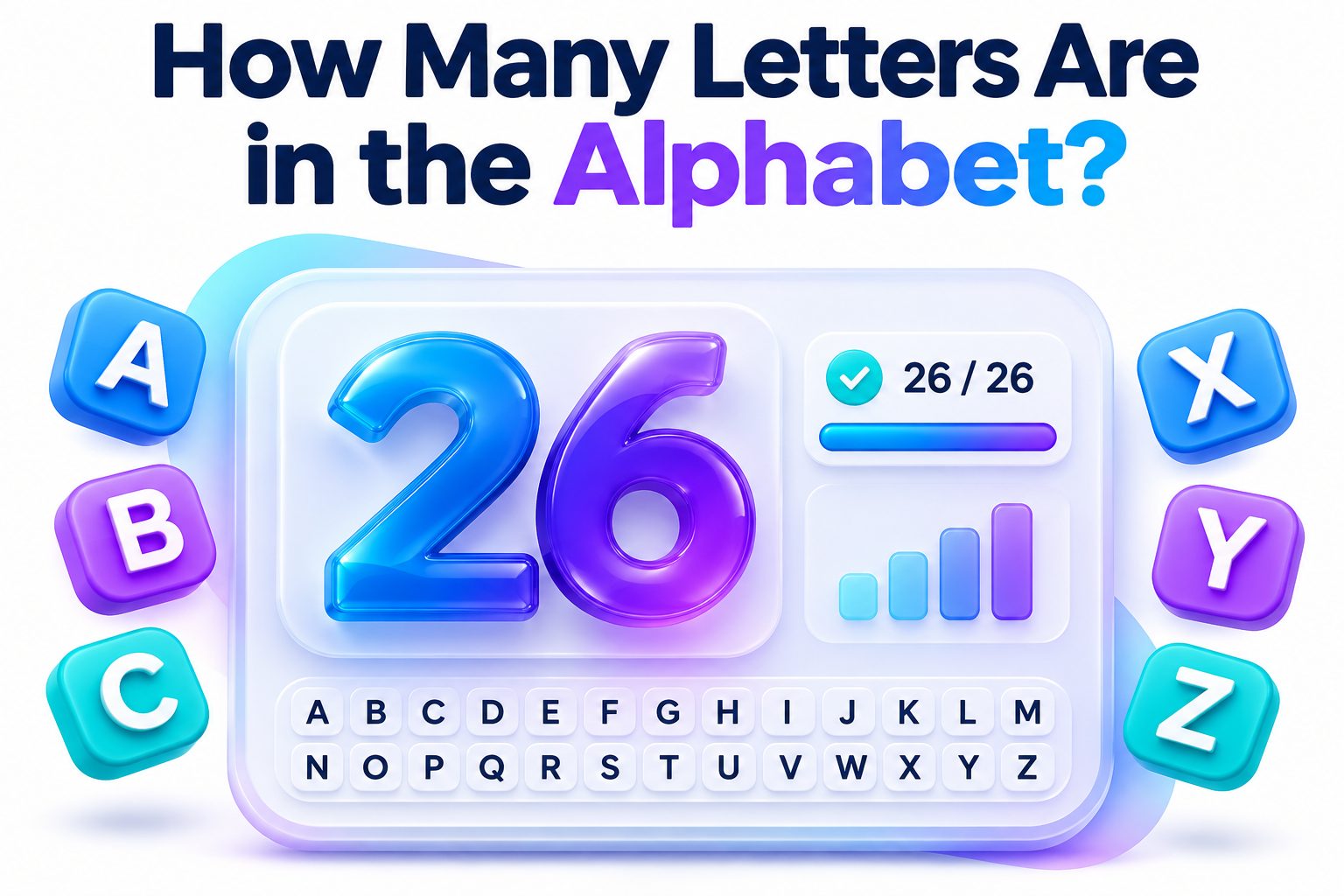
The short answer is 26. When people ask how many letters are in the alphabet, they usually mean the modern English alphabet, which runs from A to Z. It contains five conventional vowel letters—A, E, I, O, and U—and 21 consonant letters. Each letter also has an uppercase and lowercase form, but those forms do not increase the total: A and a are the same letter.
That simple answer comes with a few useful qualifications. English has not always used exactly 26 letters, and alphabets in other languages can be shorter, longer, or structured differently. Even familiar subjects such as vowel counts become less straightforward once pronunciation, borrowed words, accents, and letters such as Y enter the discussion.
This article explains the standard count, shows how the alphabet is organized, and distinguishes letters from sounds, characters, and symbols. It also covers historical changes, alphabet counts in other languages, common counting mistakes, and practical ways to help children learn all 26 English letters.
The English Alphabet Has 26 Letters
The modern English alphabet contains 26 letters. In order, they are A, B, C, D, E, F, G, H, I, J, K, L, M, N, O, P, Q, R, S, T, U, V, W, X, Y, and Z. This is the standard sequence taught in schools and used in dictionaries.
English uses a version of the Latin alphabet. The same basic writing system supports many other languages, although those languages may add accented forms, remove certain letters, or recognize extra letter combinations. For English, the accepted total remains 26 in ordinary educational, publishing, and dictionary contexts.
Uppercase and Lowercase Forms
Every English letter has an uppercase form and a lowercase form. A and a, B and b, and Z and z are paired forms of the same letters. For that reason, writing the alphabet in both cases produces 52 written shapes but still represents only 26 distinct letters.
Uppercase letters are used at the beginning of sentences, in proper nouns, and in many abbreviations. Lowercase letters appear more frequently in everyday text. Font styles can change their appearance considerably, but typography does not create new members of the alphabet.
The Complete English Alphabet in Order
Knowing the correct sequence matters because alphabetical order is used to arrange names, dictionaries, indexes, files, directories, and reference materials. The sequence begins with A and ends with Z, while M and N occupy the two central positions.
Here is the complete alphabet in uppercase and lowercase:
ABCDEFGHIJKLMNOPQRSTUVWXYZ
abcdefghijklmnopqrstuvwxyz
For easier review, the letters can be divided into short
- A, B, C, D, E
- F, G, H, I, J
- K, L, M, N, O
- P, Q, R, S, T
- U, V, W, X, Y, Z
The last group contains six letters, so learners should not assume that every group must be equal. Dividing the sequence is simply a memorization technique; it does not alter the established order.
Important facts about the sequence include:
- A is the first letter.
- Z is the twenty-sixth and final letter.
- M is the thirteenth letter.
- N is the fourteenth letter.
- There are 12 letters before M and 12 letters after N.
Vowels and Consonants in the Alphabet
English letters are commonly divided into vowels and consonants. In basic spelling instruction, A, E, I, O, and U are classified as the five vowel letters. The other 21 letters are normally classified as consonants.
This division describes letters, not every sound those letters can represent. English spelling has complex relationships between written symbols and pronunciation. A single vowel letter may represent several sounds, while two letters can work together to represent one sound.
The Role of Y
Y is usually taught as a consonant because it behaves like one at the beginning of words such as “yellow,” “yard,” and “yes.” In these examples, it represents a sound made with a narrowing of the vocal tract rather than functioning as the center of a syllable.
In words such as “myth,” “gym,” “happy,” and “sky,” Y performs the role normally associated with a vowel. That is why teachers sometimes say that English has five vowels and “sometimes Y.” More precisely, English has five conventional vowel letters, while Y can represent either a consonant sound or a vowel sound.
Vowel Letters and Vowel Sounds
The five vowel letters do not mean English has only five vowel sounds. The exact number of vowel sounds varies among accents, and linguists classify them according to pronunciation rather than spelling. Words such as “cat,” “cake,” “father,” and “about” all use A but do not share one identical vowel sound.
The reverse can also occur. Different spellings may represent similar sounds, as in “see,” “sea,” and some pronunciations of “scene.” Keeping letters and speech sounds separate makes English spelling easier to discuss accurately. Readers interested in pronunciation may also find [Internal Link: English Vowel Sounds] useful.
Letters, Sounds, Characters, and Symbols
A letter is a member of an alphabet used to represent language in writing. A sound is a spoken unit produced and heard during speech. The two concepts are connected, but English does not have a simple one-letter-to-one-sound system.
A character is a broader term for any individual unit in written or digital text. Letters are characters, but numbers, punctuation marks, spaces, and mathematical signs are characters too. A symbol can communicate an idea or function without being an alphabetic letter.
Practical examples make the differences clearer:
- “B” contains one letter, one character, and usually represents a consonant sound.
- “sh” contains two letters but often represents one speech sound.
- “7” is one character and one numeral, but it is not a letter.
- “?” is a punctuation character, not part of the alphabet.
- “é” may be treated as an accented form of E or as a distinct letter, depending on the language.
- “&” is a symbol called an ampersand, not one of the 26 modern English letters.
These distinctions matter in classrooms, password requirements, computer programming, word games, and form validation. A field requesting “eight characters,” for example, may accept letters, numbers, and punctuation rather than requiring eight alphabetic letters.
Why English Uses 26 Letters
English inherited its present alphabet largely through the Latin writing tradition. Early forms of English were also written with runic systems, while later scribes used Latin letters and adapted them to the sounds and spelling needs of the language.
The alphabet changed gradually rather than appearing in its current form at one moment. Some older letters disappeared, certain letter shapes separated into independent entries, and spelling practices became more standardized through printing, education, dictionaries, and publishing.
Letters Added or Distinguished Over Time
The classical Latin alphabet did not contain the exact same set used in modern English. I and J were once treated as variations of a single form, as were U and V. Printers and writers gradually separated their functions, and dictionaries eventually recognized them as distinct letters.
W developed from a doubled U or V form, which explains its English name, “double-u.” Its history is especially visible in other languages: French calls it “double vé,” reflecting the letter’s visual relationship to V rather than the English name.
Former English Letters
Older English writing included characters no longer found in the standard alphabet. Thorn, written Þ or þ, represented a “th” sound. Eth, written Ð or ð, also represented forms of “th.” Ash, Æ or æ, began as a combination of A and E and had specialized uses.
Wynn, written Ƿ or ƿ, represented a W-like sound before W became established. These historical characters are important when reading manuscripts or discussing the development of English, but they are not counted among the 26 letters used in modern standard English.
A Brief Timeline of Alphabet Changes
1. Early Germanic communities used runes for inscriptions and short written messages.
2. Christian missionaries and scribes introduced Latin writing for Old English.
3. Writers adapted Latin letters and retained several characters suited to English sounds.
4. Norman influence changed spelling conventions after the eleventh century.
5. Printing encouraged more consistent letterforms and reduced the use of uncommon characters.
6. J, U, and W gained recognition as separate letters over time.
7. Dictionaries, schools, and publishers reinforced the present 26-letter sequence.
The process was not perfectly uniform. Handwriting traditions, regional printing practices, and individual dictionaries differed before modern conventions settled. As a result, exact dates for some changes depend on whether the subject is letter shape, everyday use, alphabetical ordering, or formal recognition.
The Ampersand and the Alphabet
A popular claim says the ampersand was once the twenty-seventh letter of the English alphabet. The truth is more nuanced. The symbol & often appeared at the end of alphabet recitations and primers, so many children learned it immediately after Z.
The ampersand represents the Latin word “et,” meaning “and.” Its name developed from the phrase “and per se and,” used when reciting the symbol. Despite its traditional placement, modern references classify & as a logogram or symbol, not a letter.
Historical classroom practice can explain the confusion:
- Children sometimes recited A through Z and then added &.
- Certain primers printed the symbol after the alphabet.
- The phrase “and per se and” evolved into the word “ampersand.”
- Placement beside letters did not permanently make it an alphabetic letter.
- Modern English alphabetical order ends at Z.
Alphabet Counts in Other Languages
The answer 26 applies to modern English, not to every language. Several languages use Latin-based writing but modify it to suit their own sound systems. They may include diacritics, recognize additional letters, or omit letters that occur only in borrowed terms.
Other languages use entirely different scripts, and not every writing system is technically an alphabet. Some systems primarily represent consonants, syllables, or units related to meaning. Comparing raw totals therefore requires attention to how each language defines a letter.
Latin-Based Alphabets
Spanish is commonly described as having 27 letters because Ñ is recognized as a separate letter. The combinations CH and LL were historically alphabetized separately in Spanish, but they are no longer treated as independent letters by the standard modern alphabet.
German generally uses the same 26 basic Latin letters, along with Ä, Ö, Ü, and ß in its writing system. How the total is stated can depend on whether these are described as additional letters, modified letters, or special characters. The counting convention should always be identified.
Selected Alphabet Comparison
Language | Commonly stated letter count | Notable feature
English | 26 | Uses the basic modern Latin set
Spanish | 27 | Includes Ñ as a separate letter
Italian | 21 | J, K, W, X, and Y mainly occur in borrowed words
Greek | 24 | Uses the Greek alphabet
Russian | 33 | Uses a Cyrillic alphabet
Modern Hebrew | 22 | Primarily represents consonants
Arabic | 28 | Letter shapes change according to position
These counts describe common modern standards and may not capture every regional, historical, or orthographic detail. The language should be specified whenever someone asks for an alphabet count, especially in multilingual education or international software design.
Alphabet Versus Writing System
An alphabet generally uses symbols for both consonant and vowel sounds. An abjad, such as the traditional classification of Arabic or Hebrew writing, focuses primarily on consonants. An abugida organizes consonant symbols with systematic vowel modifications, while a syllabary represents syllables.
Chinese writing is not an alphabet in the usual linguistic sense. Its characters are associated with morphemes and syllables rather than individual consonant and vowel units. Japanese combines kanji with two kana syllabaries, so asking how many “letters” Japanese has can oversimplify its writing system.
Common Mistakes When Counting Letters
One frequent mistake is counting uppercase and lowercase forms separately. Although a computer may encode A and a as different characters, alphabetically they are two cases of one letter. The English total is therefore not 52.
Another mistake is including punctuation, numerals, accented forms, or keyboard keys. A standard keyboard contains many characters that do not belong to the alphabet. Likewise, the number of available typeable symbols says nothing about the number of English letters.
Avoid these common counting errors:
- Do not count uppercase and lowercase versions as separate letters.
- Do not add punctuation marks such as the apostrophe, hyphen, or period.
- Do not count digits from 0 to 9 as letters.
- Do not include the ampersand as a modern English letter.
- Do not assume every language using Latin script has 26 letters.
- Do not confuse the number of vowel letters with the number of vowel sounds.
- Do not treat font variations, such as italic A, as new letters.
Accented Letters in English Text
English sometimes uses accented forms in borrowed words, names, and expressions, including “café,” “naïve,” and “résumé.” These marks can preserve pronunciation or reflect the spelling of the source language. In everyday English, accents are sometimes omitted, though doing so may reduce clarity.
Accented characters do not expand the standard English alphabet beyond 26 letters. É is generally treated as E with an acute accent in English rather than as a separate alphabet entry. In another language, the classification and sorting rules may be different.
Digraphs and Letter Combinations
A digraph is a pair of letters representing a single sound or a closely connected sound value. Common English examples include SH, CH, TH, PH, and NG. Each example contains two written letters even when speakers perceive one main sound.
Letter combinations do not increase the size of the alphabet. The word “ship,” for instance, has four letters—S, H, I, and P—even though SH functions together in pronunciation. This distinction is useful for spelling lessons, phonics exercises, and word-counting games.
Counting Letters in Words and Sentences
To count the letters in a word, count alphabetic characters while ignoring spaces, punctuation, and numbers unless the instructions say otherwise. “Alphabet” contains eight letters. “English alphabet” contains 15 letters in total: seven in “English” and eight in “alphabet.”
Sentence-level counting depends on the purpose. A school worksheet may ask only for A–Z characters, while a software tool may classify accented letters as alphabetic too. Establishing the rule before counting prevents disagreements and inconsistent results.
A Reliable Manual Method
1. Write or copy the text clearly.
2. Cross out spaces, punctuation marks, numerals, and symbols.
3. Count each remaining alphabetic character once.
4. Include repeated letters every time they appear.
5. Decide in advance how accented characters and hyphenated terms will be handled.
Consider the sentence “A cat sleeps.” After removing spaces and the period, the remaining text is “Acatsleeps.” It contains ten letters. The uppercase A counts in exactly the same way as a lowercase letter.
Useful checks for manual counting include:
- Recount long text from the end to the beginning.
- Mark groups of five or ten letters to avoid losing your place.
- Keep repeated letters; they are separate occurrences.
- Record whether spaces and punctuation were excluded.
- Use the same rule for every item being compared.
Digital Letter Counts
Word processors usually report character counts, but their totals may include spaces and punctuation. Some tools provide separate figures for characters with spaces and characters without spaces. Neither figure necessarily equals a letter-only count.
Spreadsheet formulas, text editors, and programming languages can count letters more precisely, but results depend on the chosen rule. Unicode text makes the task more complex because an accented character may be stored as one combined character or as a base letter followed by a combining mark.
Why the Alphabet Count Matters
The 26-letter system supports basic literacy, spelling, dictionary use, indexing, filing, and written communication in English. Children need both the sequence and the ability to recognize letters in different cases, fonts, and handwriting styles.
Alphabet knowledge also matters in less obvious settings. Spreadsheet columns, school grades, catalog labels, outline levels, and reference codes often use letters in sequence. Developers use letter validation in forms, while editors rely on alphabetical sorting for glossaries and indexes.
Practical uses include:
- Finding a word in a print dictionary
- Sorting surnames in a class or customer list
- Recognizing uppercase and lowercase pairs
- Following coordinates on maps and grids
- Labeling choices or sections in a document
- Solving word games, anagrams, and ciphers
- Checking whether a form accepts letters only
People often use “alphabetical order” casually, but sorting can vary when names contain spaces, hyphens, apostrophes, numbers, or accented characters. Formal databases and indexes need defined rules rather than relying only on the familiar A-to-Z sequence.
Teaching Children All 26 Letters
Children usually benefit from learning letter names, shapes, order, and sounds together, without treating them as identical skills. A child may sing the alphabet song correctly yet struggle to identify a randomly displayed letter. Recognition outside the memorized sequence is a separate achievement.
Short, repeated activities are more effective than a single long drill. Magnetic letters, picture cards, name labels, tracing, shared reading, and sound-matching games give learners several ways to encounter the same symbols. [Internal Link: Alphabet Activities for Preschoolers] can provide further age-appropriate practice.
A Simple Learning Routine
1. Introduce two or three letters at a time, beginning with meaningful examples such as the child’s name.
2. Show both uppercase and lowercase versions of each letter.
3. Say the letter name and model a common sound it represents.
4. Ask the child to find the letter in books, labels, or signs.
5. Practice forming it with a pencil, finger paint, clay, or another suitable material.
6. Review previously learned letters before adding new ones.
7. Check recognition in a mixed order rather than relying only on A-to-Z recitation.
There is no need to insist on perfect alphabetical recitation before teaching letter sounds or simple words. These abilities can develop alongside one another. The goal is flexible recognition and use, not merely memorizing a song.
Quick Tips for Alphabet Practice
- Keep practice sessions brief and regular.
- Connect letters with familiar names and objects.
- Mix visual, spoken, and hands-on activities.
- Teach letter sounds in real words.
- Review easily confused pairs such as b and d.
- Display letters in several clear fonts.
- Praise careful effort rather than speed alone.
Some children need extra time to distinguish mirrored or visually similar forms. This is common during early learning. Consistent modeling and low-pressure repetition are generally more helpful than repeatedly correcting a child without showing the relevant visual difference.
Alphabetical Order in Everyday Use
Alphabetical order compares words from left to right. Items are first sorted by their opening letter. When two words begin with the same letter, the second letters are compared, followed by the third letters if necessary.
For example, “cap” comes before “cat” because P appears before T. “car” comes before “card” because the shorter complete word is usually placed first when all of its letters match the beginning of the longer word.
Practical Sorting Example
Consider the names Baker, Adams, Allen, Brown, and Bell. Looking only at the first letters places Adams and Allen first, followed by the B names. Comparing later letters produces this order:
1. Adams
2. Allen
3. Baker
4. Bell
5. Brown
Real sorting systems may treat capitalization, punctuation, spaces, and accented letters differently. A library catalog, phone contact list, and computer database may therefore produce slightly different results. When exact ordering matters, follow the stated style guide or software rules.
Memorable Facts About the English Alphabet
The letter E appears more frequently than most other letters in ordinary English text, while letters such as Q, X, and Z are relatively uncommon. Frequency changes by subject, writing style, and sample size, so no single ranking perfectly describes every collection of text.
The English alphabet is also used beyond ordinary prose. Braille represents letters through raised-dot patterns, Morse code assigns sequences of dots and dashes, and fingerspelling represents letters with hand shapes. These systems encode the same alphabet rather than creating additional English letters.
Other useful facts include:
- “Alphabet” comes from the names of the first two Greek letters, alpha and beta.
- A pangram is a sentence containing every letter of the alphabet.
- “The quick brown fox jumps over the lazy dog” is a well-known English pangram.
- A perfect pangram uses every letter exactly once, though natural examples are difficult to create.
- Morse code assigns a distinct signal pattern to each English letter.
- English Braille uses six-dot cells to represent letters and other information.
- Alphabet songs help preserve order but do not prove independent letter recognition.
These facts show why the alphabet is more than a memorized sequence. It provides an organized inventory that can be represented through print, touch, sound, signals, and gesture while retaining the same basic set of 26 letters.
Conclusion
The modern English alphabet contains 26 letters, arranged from A through Z. Five—A, E, I, O, and U—are conventionally classified as vowel letters, while the other 21 are consonants. Y can serve a vowel-like role in some words, but that does not change the standard total.
Uppercase and lowercase forms are paired versions of the same letters, so they should not be counted separately. Numbers, punctuation marks, accented characters, digraphs, and symbols such as the ampersand also do not add letters to the standard English set. Historical English used characters such as thorn and eth, but they are no longer included in the modern sequence.
The answer can differ when the language changes. Spanish, Greek, Russian, Arabic, and other languages have their own inventories and counting conventions. Therefore, the clearest response to how many letters are in the alphabet is 26 when “the alphabet” refers to modern English. For any other language or historical period, name the writing system before giving a total.
Frequently Asked Questions
The Number of Letters in the English Alphabet?
There are 26 letters in the modern English alphabet, beginning with A and ending with Z. Uppercase and lowercase forms represent the same letters, so displaying both cases does not raise the total to 52.
The Number of Vowels in English?
English has five conventional vowel letters: A, E, I, O, and U. The letter Y can function like a vowel in words such as “gym” and “sky,” but it is not always classified as one.
The Status of the Ampersand?
No, the ampersand is not a modern English letter. It once appeared after Z in some alphabet recitations and schoolbooks, but it represents the word “and” and is classified as a symbol or logogram.
The Middle Letters of the Alphabet?
M and N are the two middle letters. M occupies position 13, and N occupies position 14. Because the alphabet has an even total of 26 letters, it has two central positions rather than one.
The Reason Some Alphabets Have Different Counts?
Languages represent different sound systems and follow distinct writing traditions. Some add letters, accents, or special forms, while others use Greek, Cyrillic, Arabic, or another script instead of the Latin alphabet used for English.